

It was an hour drive from my friend Tyler’s house to the Ascent Summit this past week. We made that trip – there and back – over three days. That’s around 5 hours in the car (the airport on the last day was closer than his house).
So what did I do, as I was catching up with a friend?
Answer: I “vibe-coded” with AI a way to automatically generate a half-sheet for Sunday mornings. One side has announcements. The other side has sermon notes.
If you know me, you know I have complicated feelings about technology. Not to be more #nuanced than-thou, but I am at once an early adopter, and generally skeptical of the claims which many promoters of new technology make. And the claims made about generative AI have been ridiculously hyperbolic.
Anthropic’s CEO, Dario Amodei, said “We don’t know if AI is conscious” on a recent podcast. I can settle that for him: it is not.
But, as skeptical as I am of such claims, I am an early adopter. I used a computer before I could ride a bike (my dad was, and is, a computer programmer – in the early 90s and today). I made my first podcast a year after podcasting was launched. I shudder to think how much of my life is cataloged on facebook.
But, I also believe Marshall McLuhan was right when he said:
“We shape our tools and, thereafter, our tools shape us.”
In this way, I disagree with the popular notion that all technology is neutral and it’s simply “how you use it, for good or for ill” which matters. The deceptively simple act of *using* a technology shapes us in specific ways, and ways that are not within our control.
On my preaching calendar for this year, I have a sermon (yet to be written) about the Christian’s relationship with tech entitled “No neutral weapons” which is about precisely that point.
So you won’t see me touch AI when it comes to sermon writing. I don’t even use it for “research” or “prep” or “to spend less time on sermon writing and more time on strategy” or any of the dozen ways that AI is marketed to me, as a Pastor. (You should SEE the ads I get). If I were to rely on AI for sermons, it’s a legitimate question to ask: What would the church be paying me a salary for?
But the truth is: I pastor a small church. In one week I will hit the 5th year anniversary of me serving as a “Senior” Pastor. During that time, I’ve never had an administrative assistant / secretary. Organizational and ad-ministerial tasks (the tasks we need to do, to do the work of ministry) are necessary.

And, at the same time: I do not want to re-invent the wheel or spend my time fiddling with the margins and grammatical errors on a document.
As Eugene Peterson said in “The Contemplative Pastor”:
“I don’t want to dispense mimeographed handouts that describe God’s business; I want to witness out of my own experience. I don’t want to live as a parasite on the first-hand spiritual life of others, but to be personally involved with all my senses, tasting and seeing that the Lord is good.”

If the choice is between study and prayer and fiddling with formatting on a document, Lord may I choose time with you over Google docs. (And yet, how much TIME gets spent on Google docs!).
Back to Peterson’s quotation: yesterday’s mimeographed is today’s document, Canva, what-have-you.
Let me be clear: I’m NOT talking about the good and necessary wrestling with ideas which comes with the territory of the work of a human editor. I’m not talking about real artistry or design here. I’m talking about the painstaking, frustrating, annoying work of figuring out why your bullet points do not line up correctly when you paste them into a word processor. Every week. Until you retire.
Speaking of points, the point is: if I can press a button to make an announcement sheet be formatted consistently so I don’t have to think about it… I’m comfortable with that use of AI. But I admit, it does come with some friction. I’m still trying to discern my rubric for virtuous ethical use. What sort of person am I becoming by using these tools in certain ways?
I’ll describe what the program does, and you can decide if it falls within your vision of proper, or ethical, use of the technology:
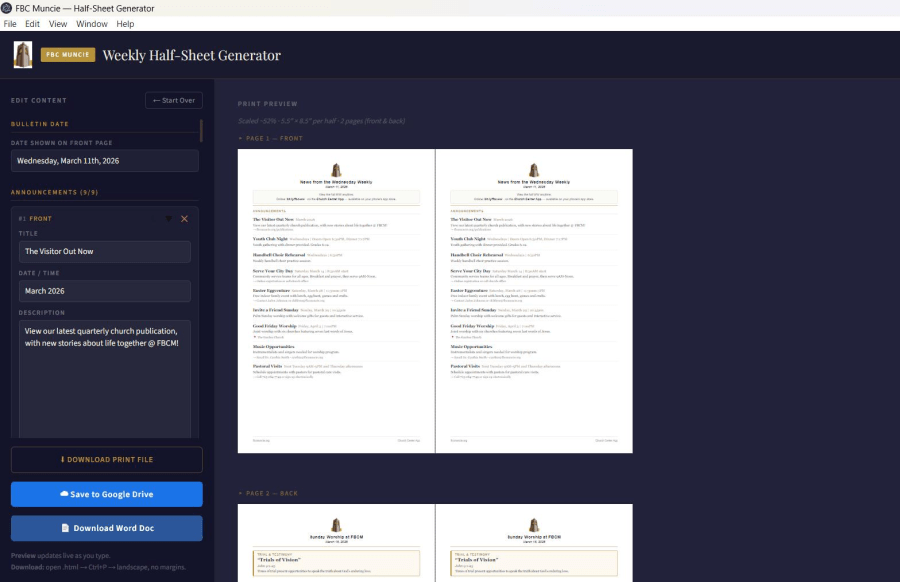

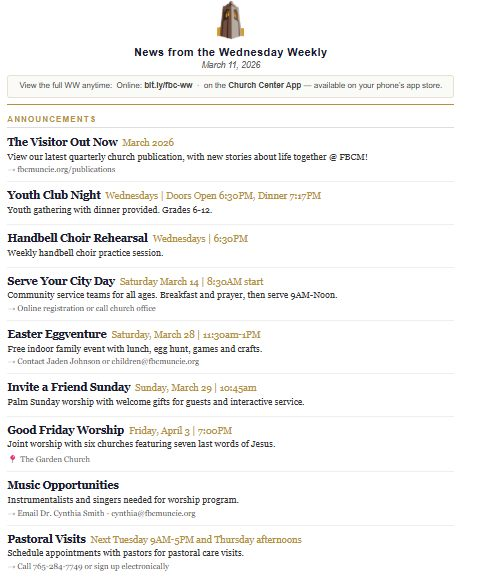
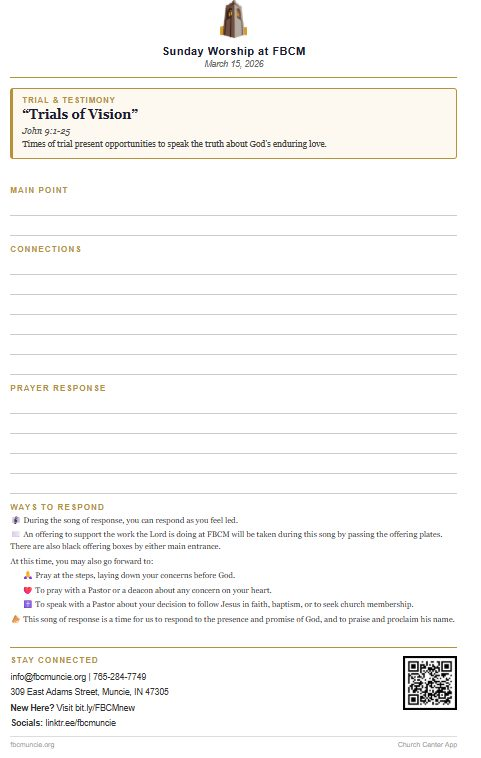
- -This program takes our already existing online news, and populates an announcement sheet. It prevents me from writing out the week’s news twice, and still allows me to provide a printed copy to our congregation, which is a convenient half sheet in size.
- -The program also automatically-calculates the date for the following Sunday, and puts the sermon text, title, and series automatically on the second page.
- -And for our “song of response” the program will put different instructions for ways to respond, depending on if that Sunday is the first of the month (communion) or any other Sunday. This, again, is done automatically.
For now, I’m satisfied with it. I click “Generate half sheet,” and it’s ready to print. When I open the file, the print dialog box automatically opens. There are three clicks and one swing of the paper cutter between nothing and half a stack of half-sheet church announcements.
My initial reaction to the project is this: I’m generally happy that there is a way to use this technology which is not so much “generative” (the machine trying to imitate the human creative process) as “organizational” (cutting time spent on re-organizing what I’ve already written).
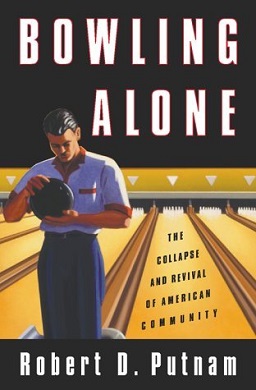
I find myself reflecting on what the proper analog is for this use of the technology. Neil Postman (“Amusing Ourselves to Death”) and Robert Putnam (“Bowling Alone”) were, to my estimation, right about the disastrous effects of home television on the social fabric. The fact we carry computers/ televisions in our pockets now, seems to me to only vindicate their claims. Large language model AI seems poised to replace human interaction in much the same way.

But, I do wonder if there is a way to use AI which is more “washing machine” than “television.” The washing machine opened up nearly a full day of time which was spent on laundry. I’m not kidding, however long you think people spent on laundry before its invention, you may want to double that figure! By freeing up that time, it allowed people to read books, make music, and enjoy one another’s company. Domestic duties could take an exceptionally long time, they were onerous and taxing. The washing machine changed this. As annoying as laundry is, believe me: it was long worse. Stomping the dirt of the clothes looks fun when it’s a thirty-second scene in “My Neighbor Totoro.” (1988) The washboard is humorous as a make-shift old-timey instrument. Using it all day? You’d pass on it. Fast.
Too often, AI feels like something which claims to “read” and summarize books for us, to make our art for us, to find the most “engaging” clip from a movie we never end up watching ourselves, so we can focus on … what?

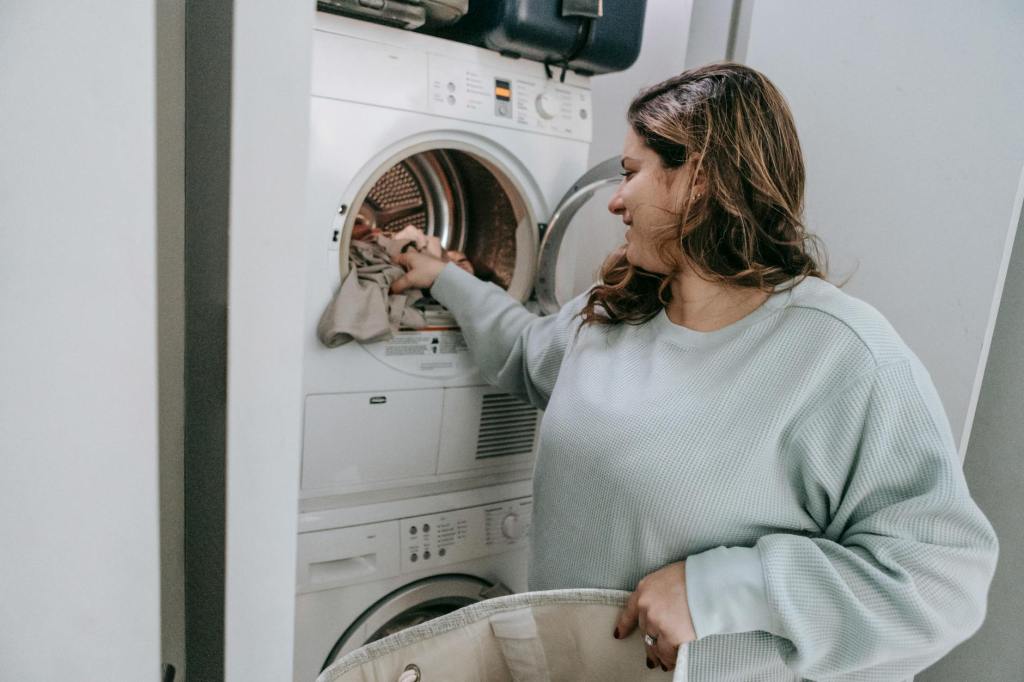
Doing laundry? Ordering door dash? Spending more, or earning more for someone else? Not enjoying or creating or relating in simple, human ways? Why DO we gravitate to uses of this technology which create a facsimile of what we should be enjoying, or doing, ourselves?
Maybe this project did not do this perfectly, but I’m happy to have found at least some way to use AI not as an imitation of a personality, but as a tool to eliminate time spent fiddling about and rearranging *objects*.
So, sorry, Ed Stetzer for compiling code during your EXCELLENT breakout session. But I was ALMOST done. Yes, the program will be tweaked in coming weeks (the golden font is too light when printed in black and white, and the font is perhaps a little small).
But, for now, I am done.

Also, let it be known that my predecessor at FBCM, Wade Allen, basically did this sort of project by actually coding himself. I am NOT the most technologically-literate Pastor FBC Muncie has had. Not even close!
But I may write the longest posts out of all of them…
And if I ever teach again, I’m still going to be the monster who busts out the blue book exams.
 Habitually Being: thoughts worth living.