
“Should pastors use AI?”
I get some truly awful emails advertising what appear to me to be large language model-assisted plagiarism services aimed at those of us who work for Christ’s church.
To be clear, I use none of them.
I’m a pastor who writes his own sermons (I wish that phrase sounded less like a ‘brag’ and more like saying, “all circles are round,” a tautology or something) who makes Canva graphics for events (alongside some volunteers), and who has no administrative assistant. And I still use AI a lot. More than most people, maybe.
Here is the distinction I’ve landed on: AI has been my short-cut to re-organize, rather than generate, text that already exists. A church is expected to communicate in a lot of ways: websites, bulletins, emails, handouts, social posts. And it draws from a lot of sources: a preaching calendar with series, texts and titles; a ministry calendar the church approved months ago; news requests in an inbox; graphics in Canva. Nearly every task that used to mean “copy and paste” or “open fifteen tabs” has shrunk to a fraction of what it was.
This fall, First Baptist Church Muncie began the rhythms of a plan we call Salt & Light 2029, and I’ve come to see this unglamorous work behind the work as something that serves that plan. Here’s why.
A seminary professor once dubbed “ad-ministry” the things we do to do the things we’re called to do. And that’s what I’ve tried to use these tools to do.
Where we are
FBCM has worshiped in downtown Muncie since 1859. Today we are a smaller congregation in a large, historic building, with one full-time pastor and a part-time co-pastor, my wife, Kendall Ellis. Our church has no administrative help or comms assistant. We do have dedicated office volunteers, but most of us aren’t comfortable with technology. That isn’t a scandal even if it’s relaity. It’s a situation many congregations share. It also means a lot of work a larger church would spread across an office lands on a very limited number of people.
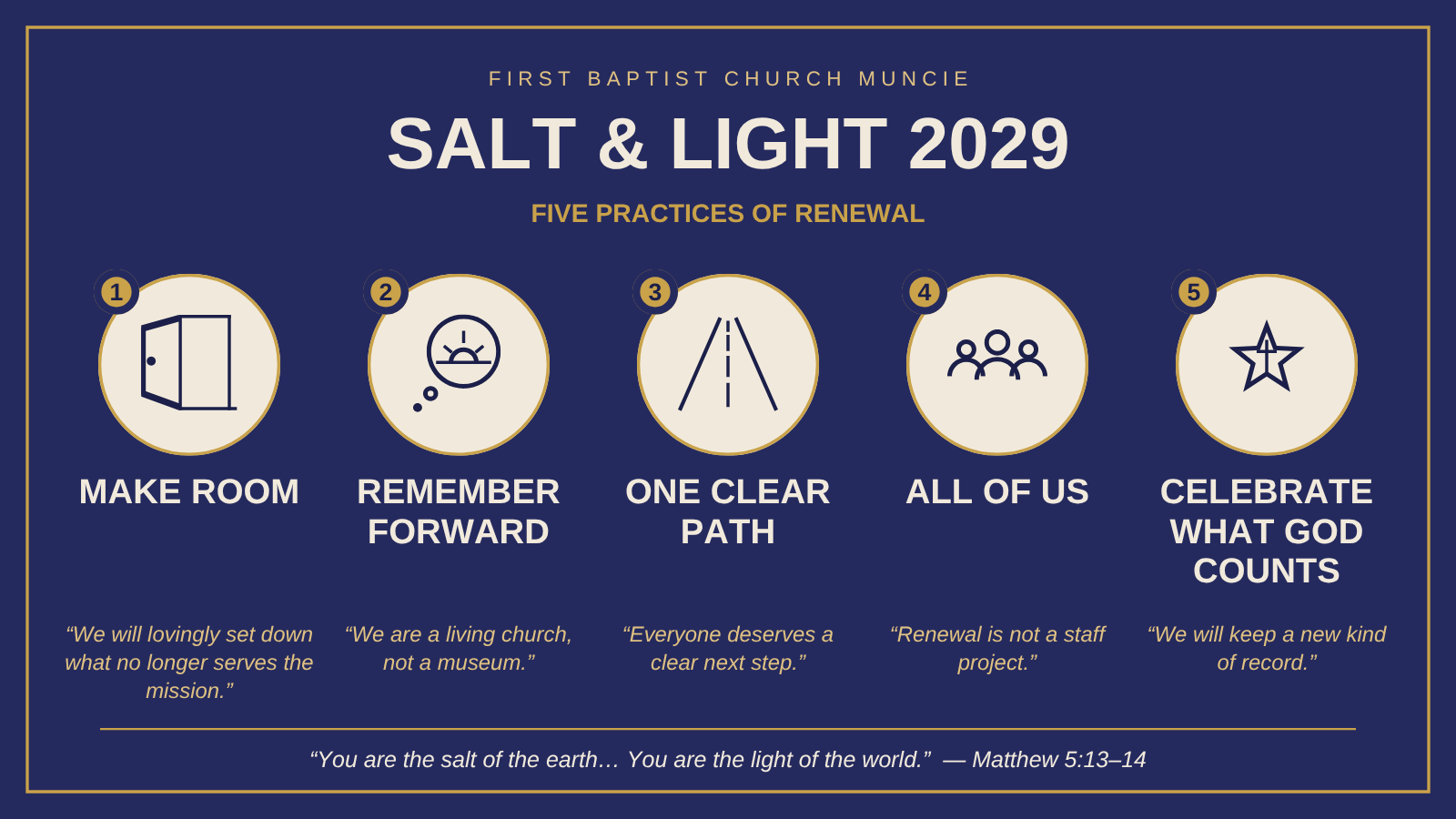
At our Vision Lunch in August, the congregation adopted Salt & Light 2029, a plan rooted in Jesus’ words in Matthew 5:13–16. It was unanimously approved, and includes five practices of renewal:
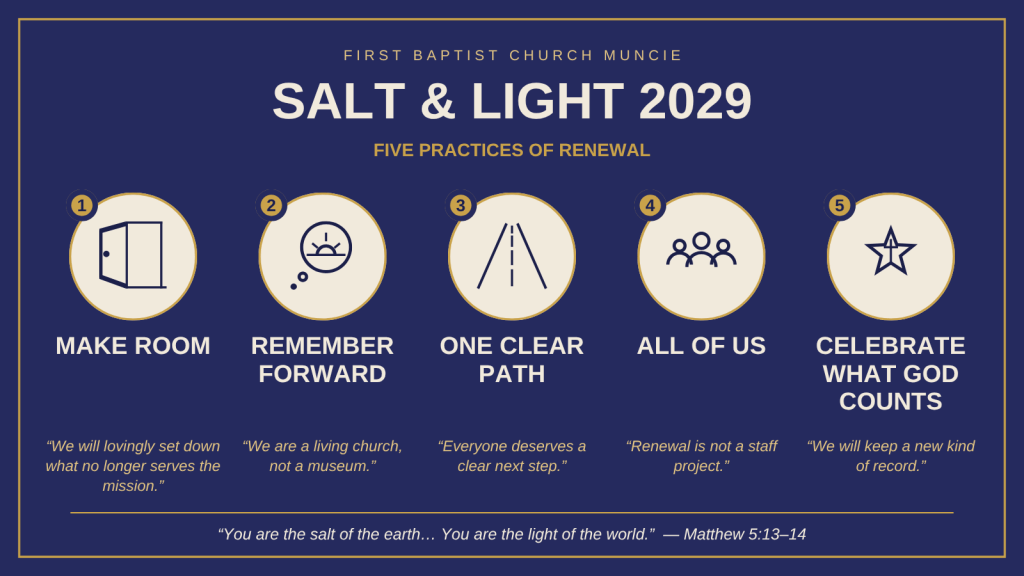
To be clear, the computers aren’t performing any of these five practices. The church does that; machines can’t. The tools mostly help us focus our limited time and hands, and free us up for the practices themselves. Ideally at least: more washing machine than television, to use my previous analogy. What follows is how some new, mostly invisible systems serve each of them. None of it is heroic. It’s housekeeping. But housekeeping is how a household makes room for guests.
Make Room: “We will lovingly set down what no longer serves the mission.”
Most of what we’ve set down this fall isn’t a ministry at all. It’s busywork.
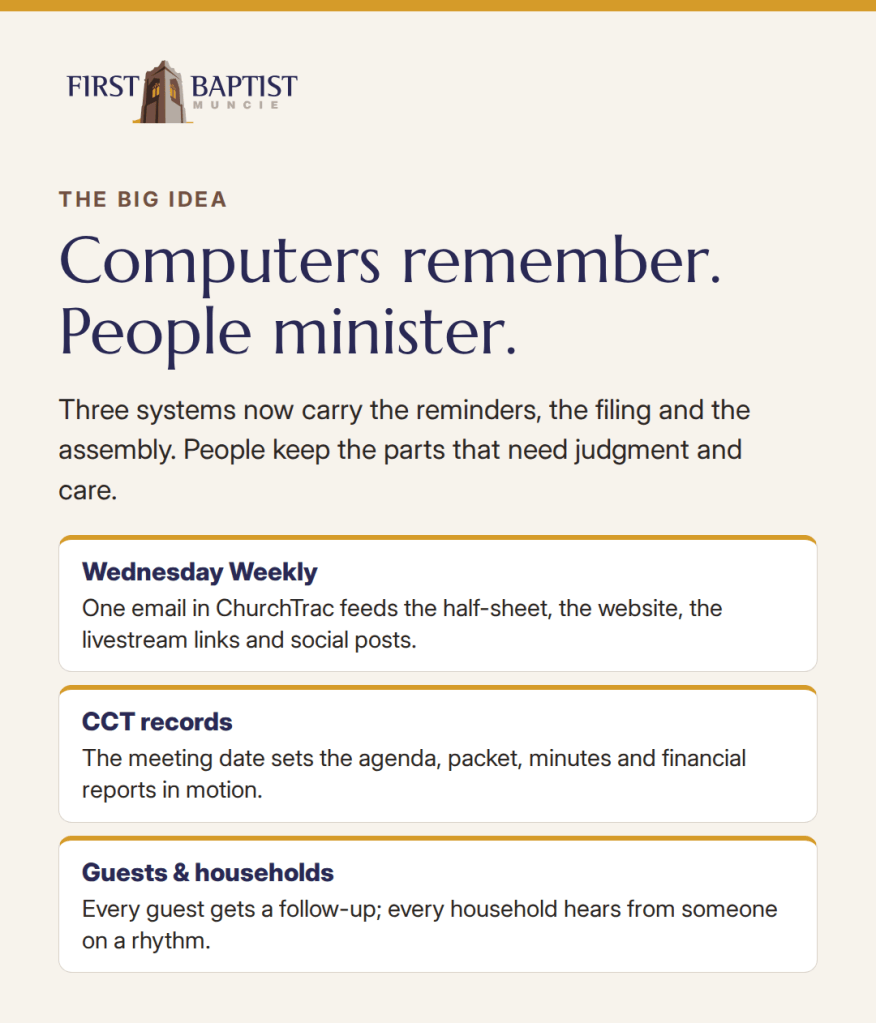
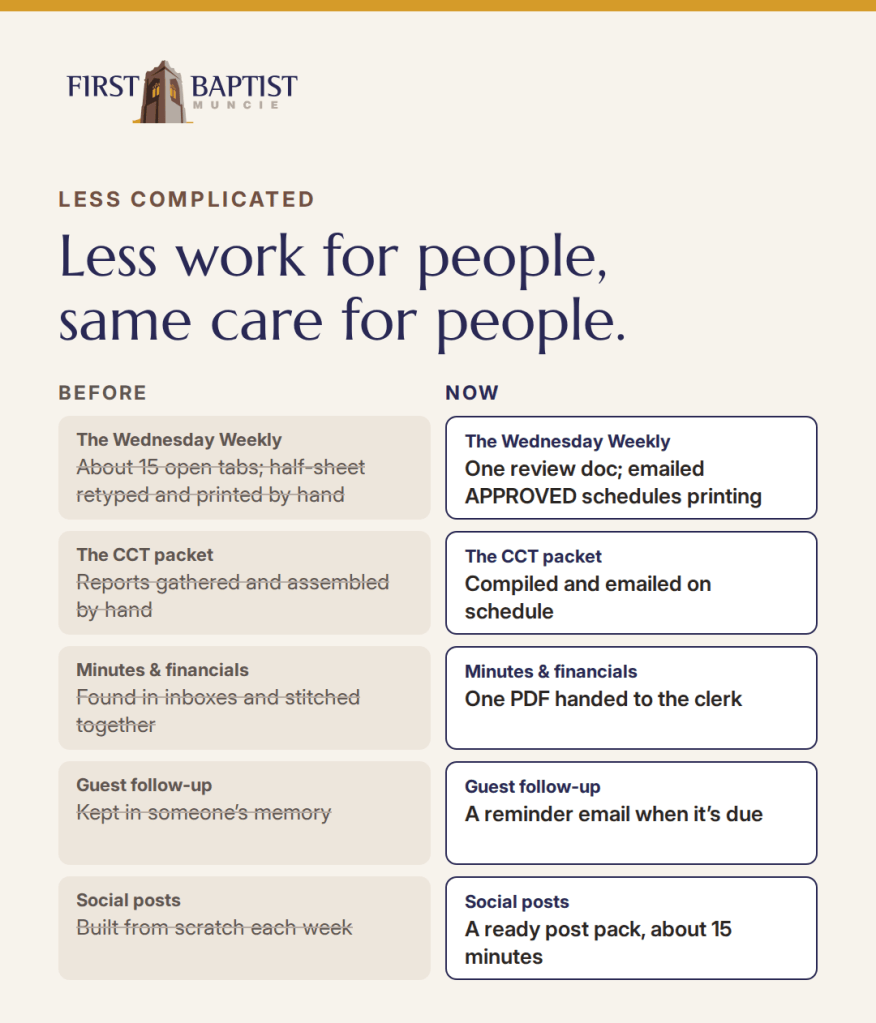
Take our weekly email, the Wednesday Weekly. Building it used to mean (as I mentioned) lots of open tabs: the submissions inbox, two calendar docs, Canva, Planning Center, ChurchTrac, Drive, the website editor and YouTube, maybe more. Then the printed half-sheet handed out Sundays (Order of Worship + announcements) was rebuilt from that email by copy and paste and printed by hand.
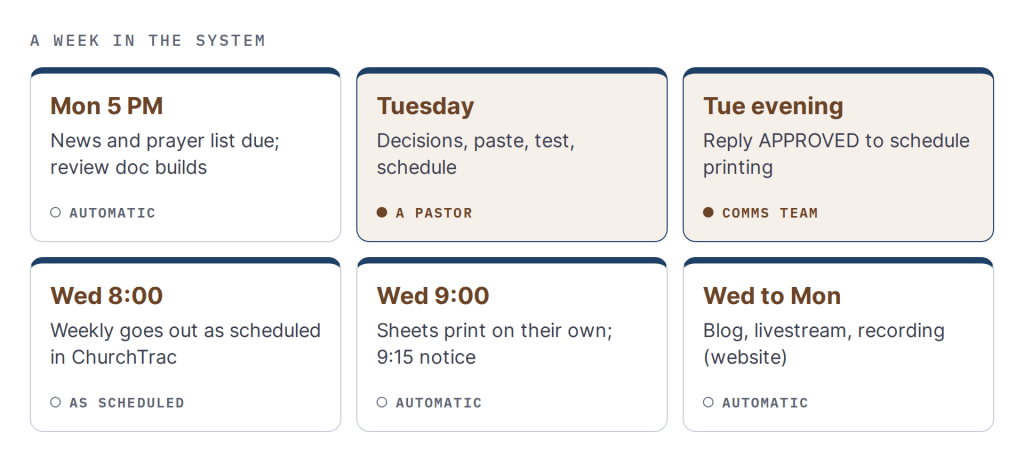
Now news is due Monday at 5 PM. A scheduled task running in the church’s own info@ account reads the submissions, both calendars and our Canva folders, and builds one Google Doc: what came in, what to add, what to drop, and what needs a pastor’s decision. A pastor makes those decisions, pastes the result into one email in ChurchTrac, and schedules it.
Everything else follows from that one email. The test copy kicks off a build that pulls Sunday’s order of worship from Planning Center and lays out that half-sheet we mentioned, that greeters give to people when they walk in to Worship.
It also automatically creates a Who’s Serving roster. That’s in the email and printed and it includes who does what on a service, and even what song they walk up during to, for example, read scripture (it all updates automatically).
A proof of these two documents arrives by email. Someone (whoever does the Wednesday weekly, right now it’s me, but it’s easy to change who the email goes to) replies APPROVED or corrects it just by replying with what’s wrong.
Assuming the reply “Approved” is sent, on Wednesday morning, the worship guide and announcement half-sheet print themselves in the church workroom, with no one in the office. The sermon preview goes up on the church website, links itself to Sunday’s livestream, and then points to the recording afterward. On Thursday, a post pack for Facebook and Instagram lands in an inbox, ready for a person to schedule on Meta business suite (where a lot of non-profit and businesses schedule Instagram and Facebook posts).
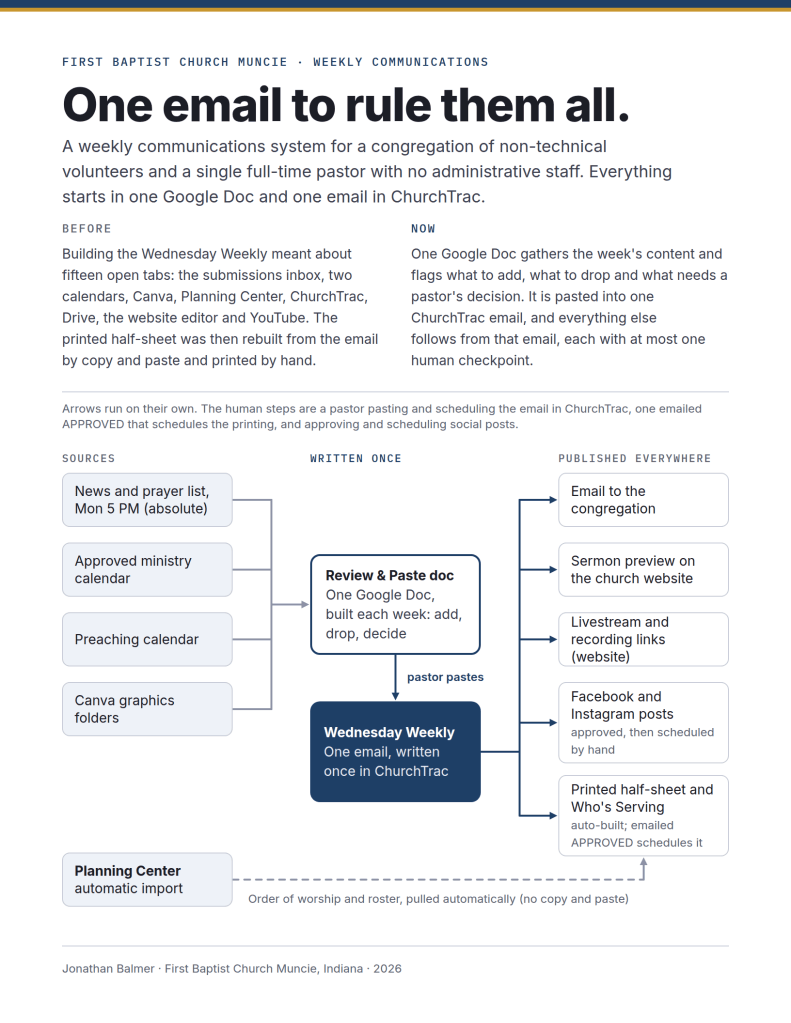
Yes, I riffed off Tolkien’s One Ring to describe this, and yes, it’s a little unsettling. But as much as Silicon Valley, or even the Defense Industry, tries its best to misunderstand Tolkien and crib his names, I’m not trying to do the same here. At least I hope not. If I turn invisible or start calling the “organize info and automate email” machine “My precious,” you have permission to take it and throw it in Mount Doom.
I’ve tried to build the opposite of something that takes control: every arrow in that diagram ends at a person (and every piece of content is originally written by a person). Nothing posts on its own or reaches the congregation on its own. The system re-arranges, people decide if it’s right, and no one has to be in the office for the stuff to click a bunch of buttons or search for a file to print. But the sharp knife that cuts the half-sheets (ahem, the paper cutter), remains out of robot hands. For now.
Remember Forward: “We are a living church, not a museum.”
The to-do list used to live in someone’s head, or someone’s inbox. Each month our Church Coordination Team (CCT) needed a packet of ministry reports, an agenda, last month’s minutes, corrections, and the treasurer’s financial reports, all eventually combined into one file for the congregation. If the person who remembered every piece was away, we waited. Or we forgot..
Now ministry coordinators report in one Google Form. Two small scripts, keyed to the meeting date, gather together the packet, send the reminders, file the financial reports by month, and hand the clerk one combined PDF with numbered steps. In short all the moving files between folders on Google Drive is done for us. The clerk still writes the minutes and still presses send. The scripts never write to the congregation and never edit a word of the record.
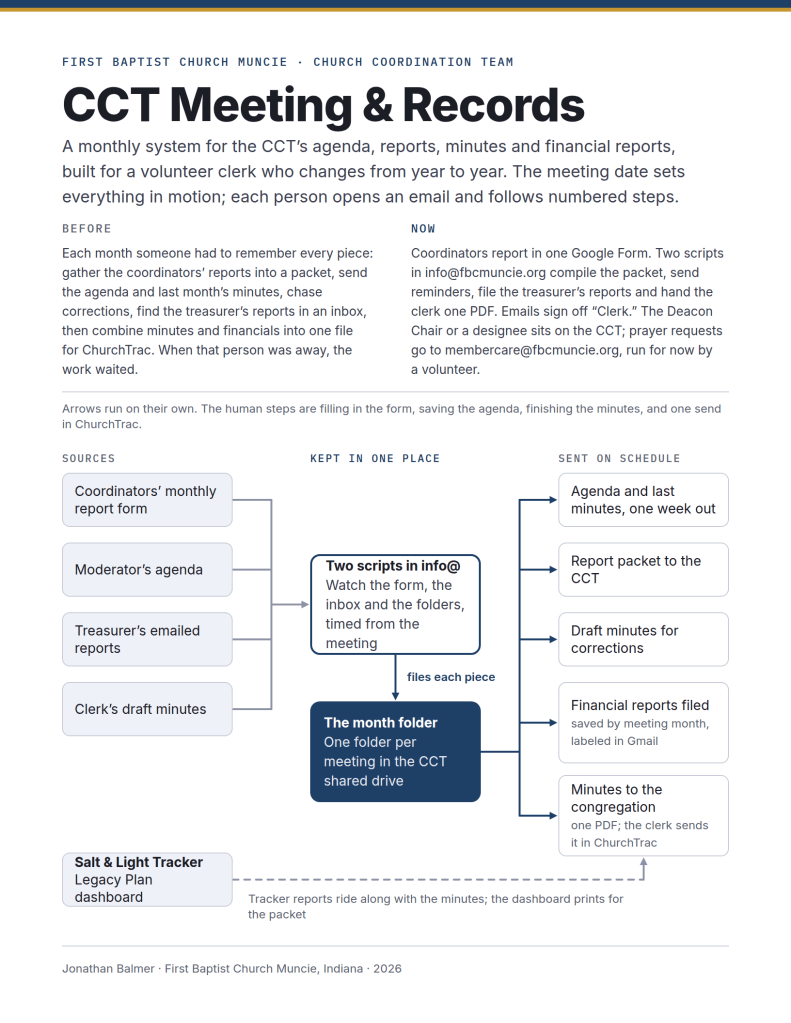
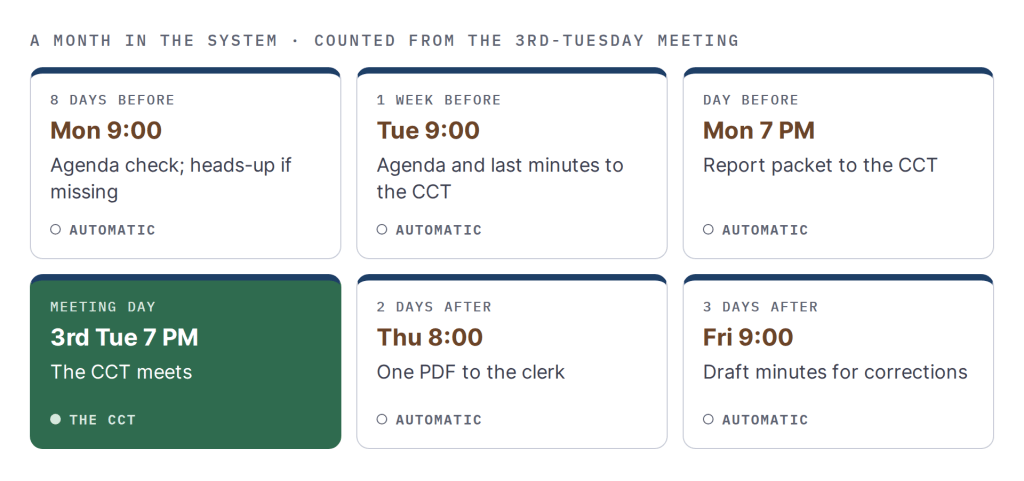
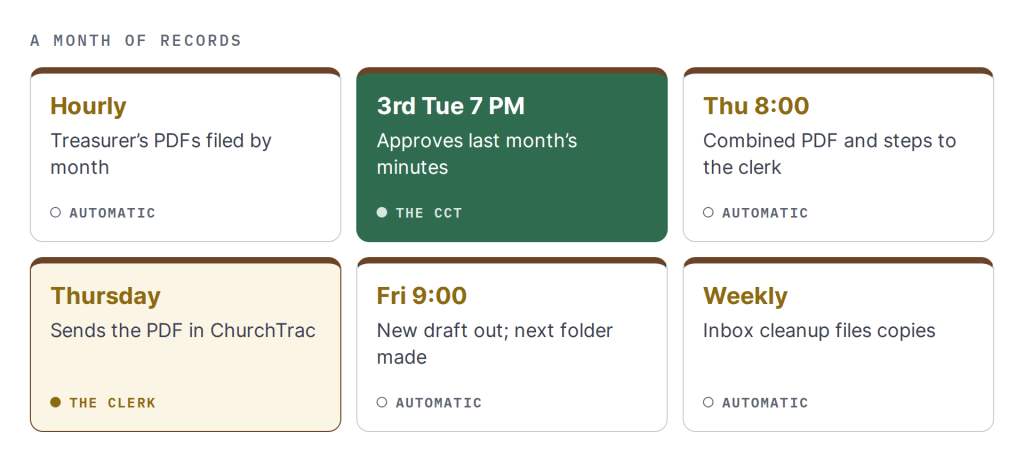
Remembering forward means honoring what the church has been for 167 years without asking every new volunteer to remember where someone else saved some file. Good records are meant to be a gift to whoever takes up a position. They hopefully prevents panic when someone hands over a task. I don’t want someone taking a break to be an emergency.
One Clear Path: “Everyone deserves a clear next step.”
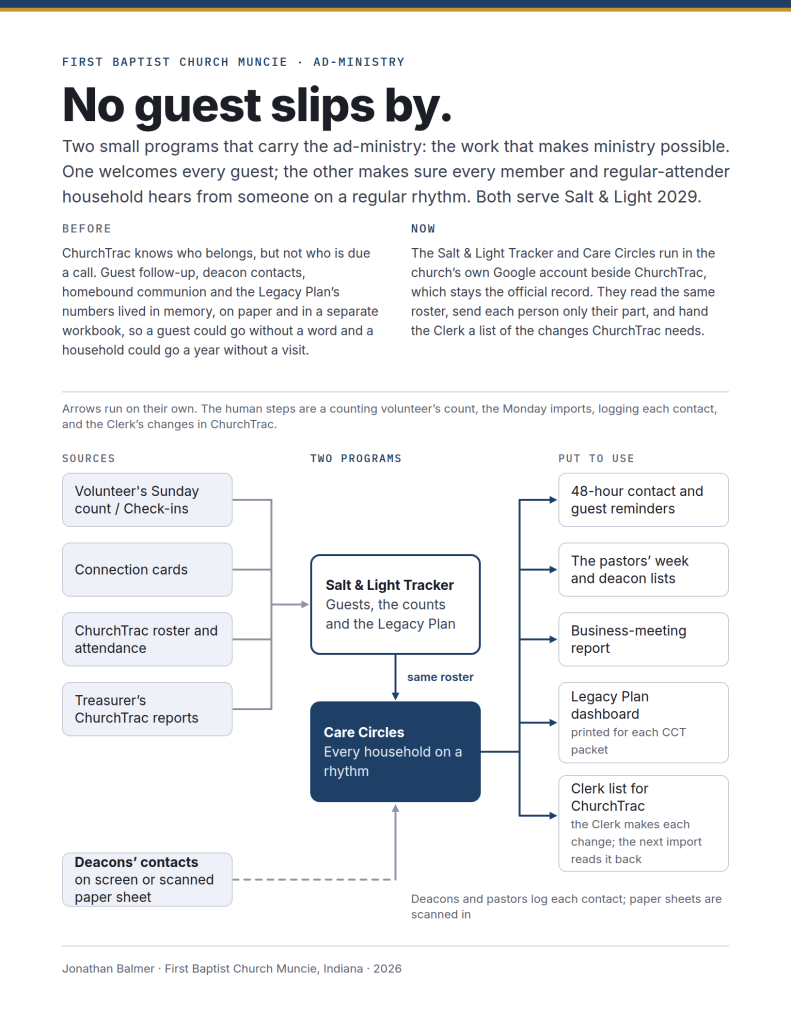
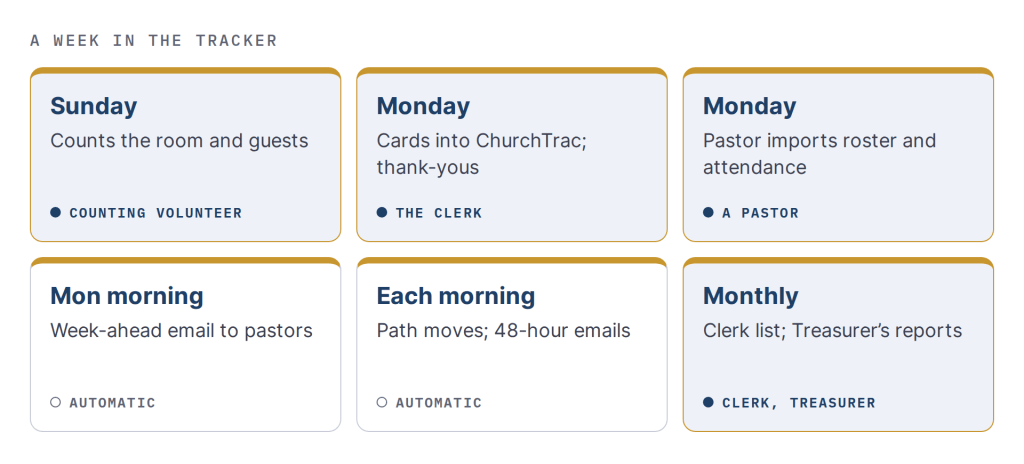
Our new Salt & Light Tracker exists for several reasons. One important one is so no guest slips by us unnoticed.
A volunteer counts the room on Sunday and submits it from a phone. People also check-in at a Kiosk and that’s logged into ChurchTrac, our church management software. Connection cards go into ChurchTrac. The goal is for every first-time guest gets a contact within 48 hours and a thank-you card, and the pastors get a reminder email when that contact is due. As guests return, the next steps open up: a ministry to try, lunch with the pastors, a small group, a place to serve, and the New Member Class.
That class met this October during the Sunday school hour. Alongside it, our Invite a Friend Sundays give members a simple, specific reason to bring someone along. The Tracker doesn’t replace actually showing hospitality and welcoming others. It just makes clear what a good next step might be and prompts us to take it. We’re the ones who made the steps, not the machine. Think of it is like setting an alarm.
All of Us: “Renewal is not a staff project.”
The companion program, Care Circles, makes sure every member and regular-attender household hears from someone on a regular rhythm. Each household is in a deacon’s circle, with a contact each quarter and monthly communion for the homebound. Deacons who like screens see their own circle in large type, with a number to tap. Deacons who prefer paper tick a large-print sheet, and a pastor scans it in.
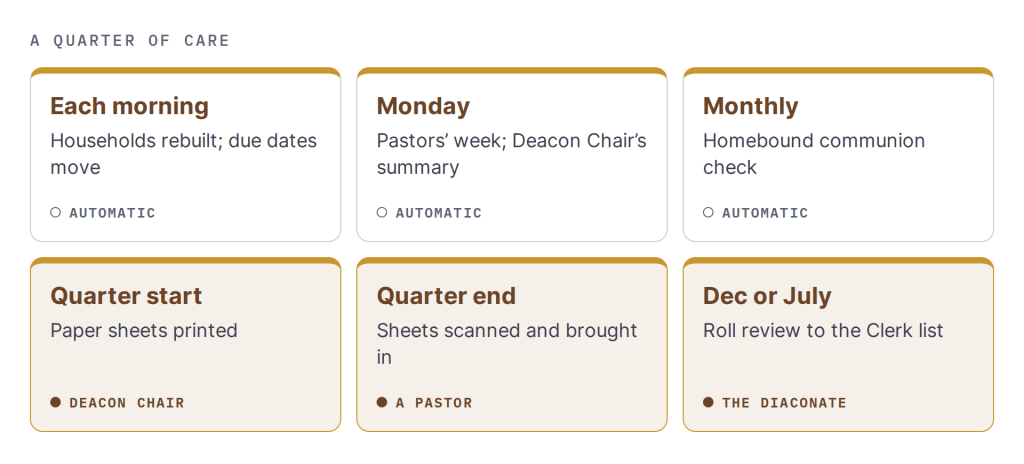
Prayer requests works the same way: one address, membercare@fbcmuncie.org, any subject, any words. A short summary of exactly what was submitted goes to the volunteer who updates our Prayer List page. No one gets an automatic reply. Those need to be personal! Prayer details never go out in an email.
Underneath all of this is a principle: everything runs under church accounts, not a pastor’s personal login. Names that change live in one settings sheet. A new volunteer joins by being added to one email group. Volunteer roles rotate, and the church’s tools should belong to the church, not to whoever happened to set them up.
Celebrate What God Counts: “We will keep a new kind of record.”
Churches are good at counting attendance and budget. Those matter, and our leadership now watches them honestly. But we aim to count in a Godly way: not just attendance and budget but stories of lives changed by the Holy Spirit, testimonies of neighbors served, accounts of guests who came and returned after experiencing hospitality.
So the Tracker counts first-time guests and returns, lunch invitations, new members, baptisms, stories shared with permission, and neighbors served. It can print those for any date range, so a business meeting can hear about more than money.
Why I’m doing this
When I’m not troubleshooting the printer for a frustrated volunteer doing a tech task they really didn’t want to do (but feel they should, out of obligation for the church they love), then I am perhaps spending time with that person talking about their family, or their spouse’s diagnosis, or their life of prayer. When I’m not copying and pasting, or opening 15 tabs (and forgetting where something is), I’m having more time with a biblical text, or to make plans ahead of time to have lunch with a recent visitor to our church. If the computer can remember the rearranging of texts, I hope I can spend more time being what Eugene Peterson called, to paraphrase, the unbusy, unhurried Pastor.
We’re in a difficult season; no sugar-coating it. But Salt & Light is about a church choosing to spend its time and energy on what Jesus called us to be. These tools are just one way of winning back a little more of that time.
The sermon needs to be the result of time with holy scripture and the Lord and the people he has entrusted me to serve. For copying and pasting from the church newsletter, to the website, to the social media post … I’ll leave the re-arranging to the big-word-guessing-machine.
What do you make of this? Better than the “sermon help” I’m constantly advertised?
Or am I fooling myself?

